Pierre-Auguste Renoir · 1881
Two Sisters (On the Terrace)
A 6-colour reading of Two Sisters (On the Terrace), sampled from the canvas itself.
Art Institute of Chicago
Tap any swatch to copy. Ground colours are the three largest areas of the canvas; accent colours are chosen for intensity and may cover very little — which is exactly why they carry the painting. Percentages are each colour's share of the whole canvas, so these six will not add up to 100%: they are six of the 26 distinct colour regions measured, not a division of the surface. How these were sampled
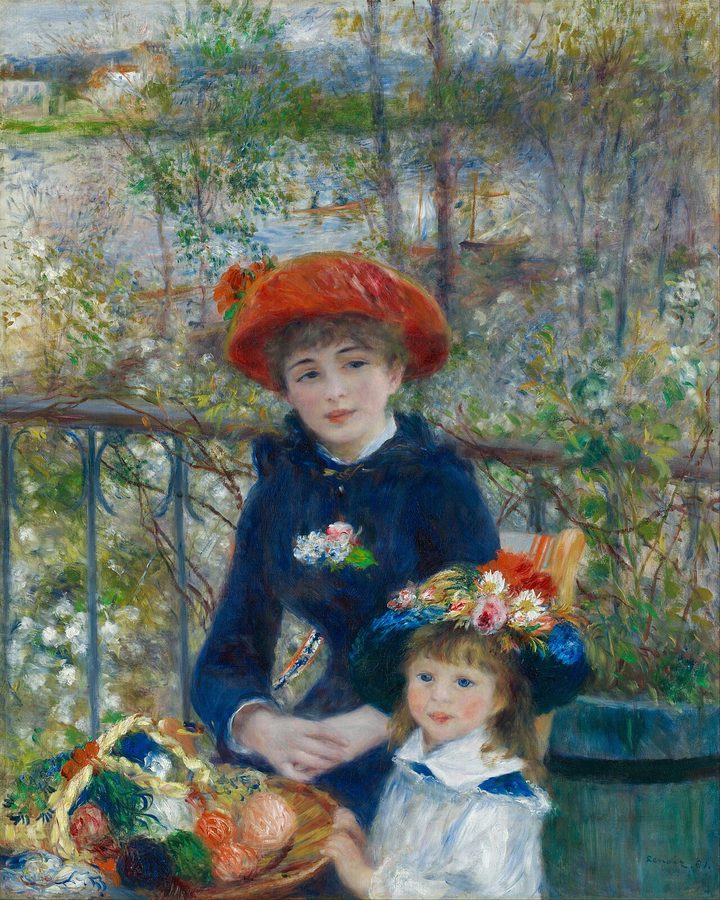
This palette runs from #798483 at its lightest to #08467E at its darkest, with 3 accent notes carrying most of the chromatic interest. The three largest areas of the painting set the base; the accents are the colours that give the work its character without necessarily covering much of it.
Every swatch is a colour that genuinely occurs on the surface — each one is snapped to the nearest real pixel rather than averaged, so nothing here is a colour the painter never actually put down.
Accessibility
WCAG contrast ratios between every color pair. Use the strongest combinations for text; the weakest ones make good decorative backgrounds.
Strongest pair: #798483 on #08467E — 2.49:1 (Fail)
- #798483·#77786A
- #798483·#5C6261
- #798483·#A03E23
- #798483·#305651
- #798483·#08467E
- #77786A·#5C6261
- #77786A·#A03E23
- #77786A·#305651
- #77786A·#08467E
- #5C6261·#A03E23
- #5C6261·#305651
- #5C6261·#08467E
- #A03E23·#305651
- #A03E23·#08467E
- #305651·#08467E
How to read this
- AAA
- Passes WCAG 2.1 AAA for normal text — the highest accessibility bar.
- AA
- Passes WCAG 2.1 AA for normal text. Standard production requirement.
- AA Large
- Passes WCAG 2.1 AA for large text only (18pt+ or 14pt+ bold). Avoid for body copy.
- Fail
- Below WCAG 2.1 AA. Fine for decorative use — not for text.
Export
One click — no signup, no watermark.
Studio
Paint this palette
These are the materials a colour study actually gets made with.
Affiliate links — as an Amazon Associate we earn from qualifying purchases.
-
Kuretake
Gansai Tambi 36
The larger pan set. More range means mixing toward a specific plate rather than approximating it from six colours.
Listed on Amazon as Kuretake GANSAI TAMBI Watercolor Paint Set 36 Colors
See price on Amazon -
140 lb cold press is the weight that takes a wet wash without buckling — the paper most colour studies end up on.
Listed on Amazon as Strathmore 300 Series Tape Bound Watercolor Pad, 140 lb. Cold Press, 11 X 15 inches, White, 12 Sheets (360-111)
See price on Amazon -
Pentel
Fude Touch brush sign pen
A felt brush tip for the labelling and linework around a swatch study — the annotation half of a colour notebook.
Listed on Amazon as Pentel Fude Touch Sign Pen, Black, Felt Pen Like Brush Stroke (SES15C-A) 3 Pieces
See price on Amazon -
When a palette leaves the screen, this is the shared vocabulary between you and the press. Coated and uncoated because the same ink is not the same colour on both.
Listed on Amazon as Pantone Formula Guide – Coated & Uncoated | Professional PMS Color Matching System for Print, Packaging & Graphic Design | GP1601B
See price on Amazon -
This site hands you hex codes. Color Bridge is the deck that shows what an RGB or HTML value becomes as CMYK ink, and which Pantone spot sits nearest it — the translation step between a screen palette and a printed one. Coated and uncoated because the same ink is not the same colour on both stocks.
Listed on Amazon as Pantone GP6102B Color Bridge Guide Set Coated & Uncoated, Multi-Colour
See price on Amazon -
Pantone
Color Bridge Guide — coated
The coated half on its own — Pantone to CMYK, RGB and HTML in a single fan. The smaller entry point if your work only ever goes onto coated stock.
Listed on Amazon as Pantone Color Bridge Guide Coated | Pantone to CMYK, RGB & HTML Color Matching Fan Deck for Graphic Design, Branding & Print | GG6103B
See price on Amazon -
Calibrite
ColorChecker Studio spectrophotometer
A spectrophotometer profiles the whole chain — display, printer, projector, scanner — so the colour you picked is the colour that comes out the other end. The full-fidelity option for work that ends up printed.
Listed on Amazon as Calibrite ColorChecker Studio Spectrophotometer for Complete Color Management for Display, Projector, Printer and Scanner Profiling
See price on Amazon -
Calibrite
Display Plus HL colorimeter kit
A colorimeter calibrates the monitor itself. Worth saying plainly: an uncalibrated screen is the most common reason a palette that looked right on your desk looks wrong everywhere else.
Listed on Amazon as Calibrite Video Photo Kit with Display Plus HL Colorimeter and ColorChecker Passport Video 2, 10,000 Nit Monitor Calibration, Camera Color Matching
See price on Amazon -
Calibrite
ColorChecker Passport Photo 2
A pocket target for fixing white balance and exposure at the moment of capture — the step before any colour correction, if your palette starts from a photograph rather than a screen.
Listed on Amazon as Calibrite ColorChecker Passport Photo 2 Portable Color Calibration Kit for Photo and Video, 4 Target Set for White Balance, Exposure and Creative Look
See price on Amazon -
Kuretake
Gansai Tambi 24 — Art Nouveau
Gansai are traditional Japanese watercolour pans — dense, matte and easy to mix, the closest everyday medium to the flat printed colour Wada's plates were made in. This is the Art Nouveau-themed 'II' edition, a different 24 to the standard set.
Listed on Amazon as Kuretake GANSAI TAMBI Watercolor Paint Set 24 Colors II - Art Nouveau
See price on Amazon
Amazon Associates affiliate links — your price is unchanged and a small commission keeps the archive free. As an Amazon Associate we earn from qualifying purchases.
Library
Further reading
Book links are Amazon Associates affiliate links. Your price is unchanged; a small commission supports the archive. As an Amazon Associate we earn from qualifying purchases.

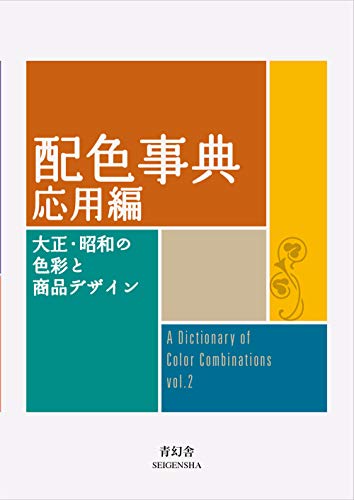

Torn between the two Wada dictionaries? Vol 1 vs Vol 2, compared plate by plate →
Book links are Amazon Associates affiliate links. Your price is unchanged; a small commission supports the archive. As an Amazon Associate we earn from qualifying purchases.